
Chemical analyses of INDAAF samples (rainwater, gases, and aerosols) are performed at the Chemistry Service of the Laboratoire d’Aérologie (LAERO) in Toulouse, France. The LAERO Chemistry Service analyzes more than 7,000 samples each year, mainly within the framework of the ACTRIS-FR (Aerosol, Clouds and Trace Gases Research Infrastructure – France) and INDAAF programmes, but also for the Service National d’Observation (SNO) CLAP (CLimate-relevant Aerosol Properties from near-surface observations) at the Pic du Midi site (France), as well as for other collaborative projects.
The service is also responsible for the preparation of INDAAF samples, including passive gas samplers and aerosol filters (pre-treatment and weighing at LAERO), and for carrying out pH and conductivity measurements on rainwater samples.
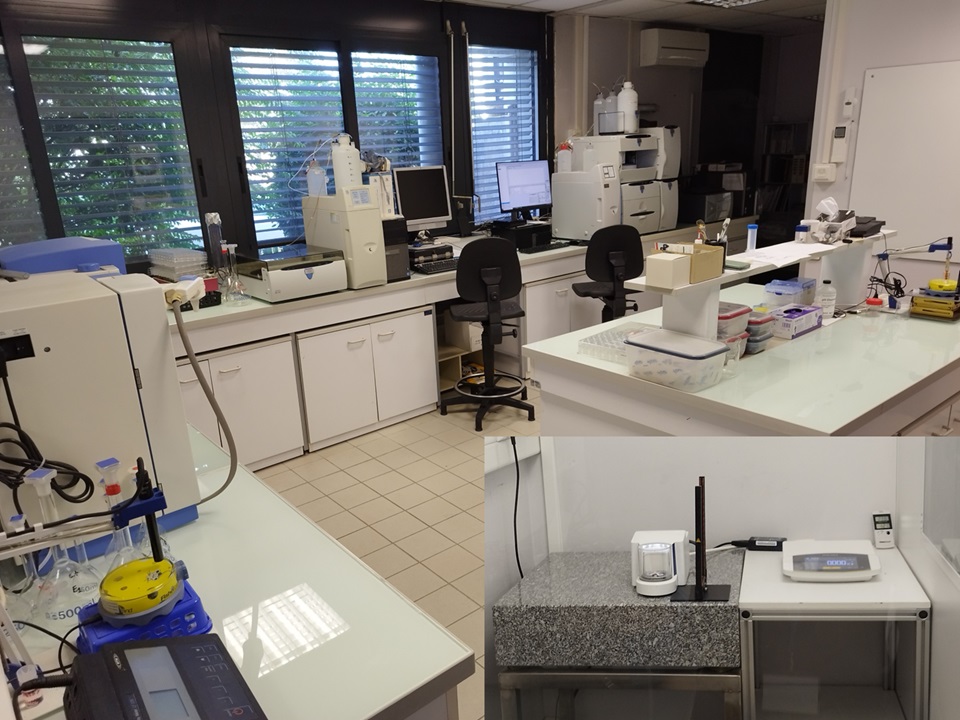
Main equipments :
Ion Chromatography (IC) is an analytical technique based on the separation of ions using an ion-exchange column, which is positively charged for anion separation and negatively charged for cation separation.
IC analyses are mainly performed on three types of INDAAF samples :
- Rainwater samples, to determine the chemical composition of precipitation (major inorganic and organic ions) ;
- Impregnated filters collected by passive samplers, used to quantify atmospheric gas concentrations, including SO₂, NH₃, NO₂, HNO₃, and O₃ ;
- Teflon aerosol filters, to determine the water-soluble mineral and organic fractions of aerosols collected on these filters.
The LAERO Chemistry Service is equipped with :
- Three THERMO DIONEX ion chromatographs : INUVION, AQUION and ICS5000+ ;
- Chromeleon™ THERMO DIONEX software for data acquisition and reprocessing ;
- THERMO DIONEX automatic sample loaders.
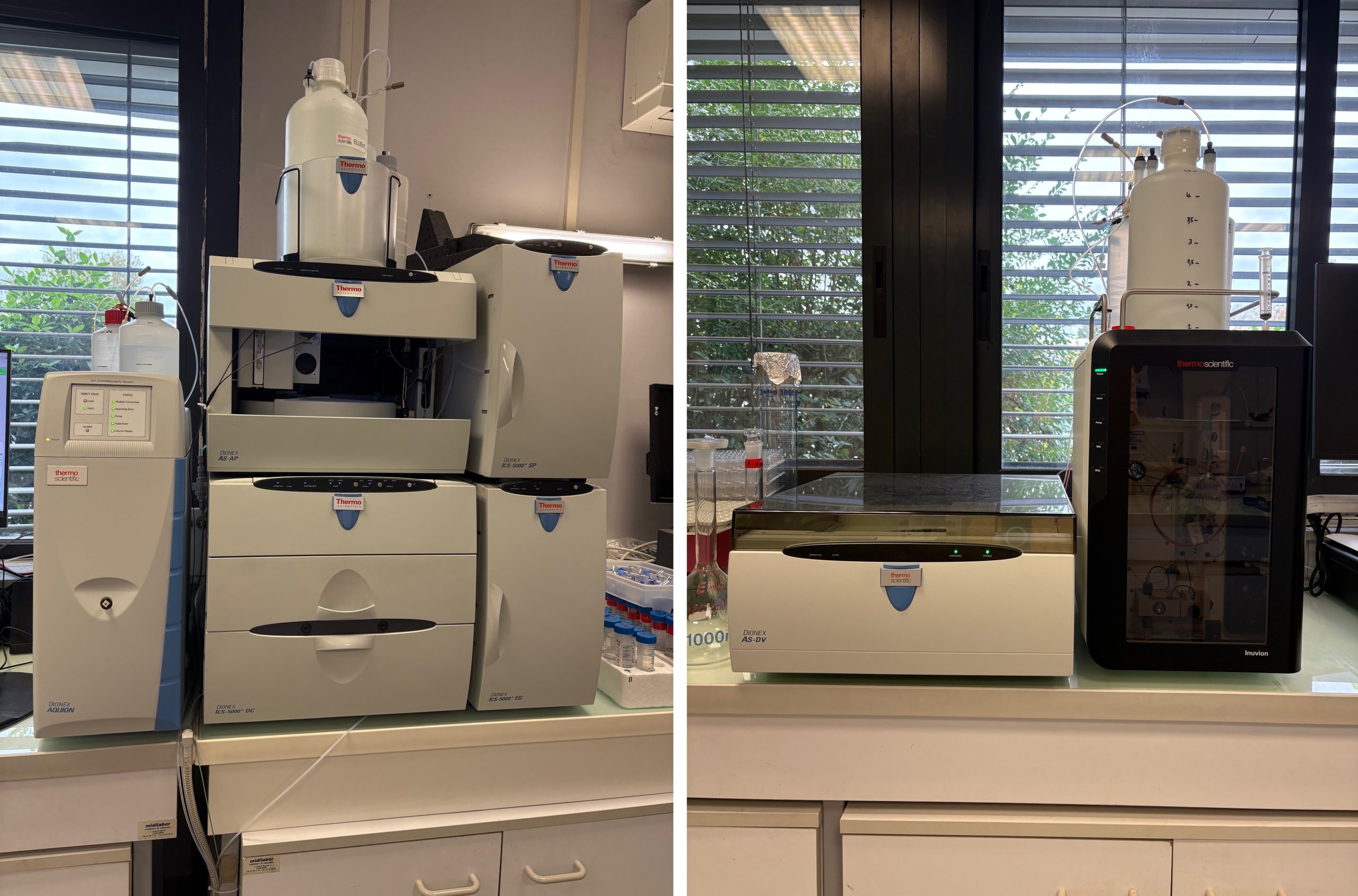
Analytical protocols :
| Devices (Operating Software) | Analysed Species | Columns (4mm) (Duration of analysis) | Suppression | Eluent composition (Flow) |
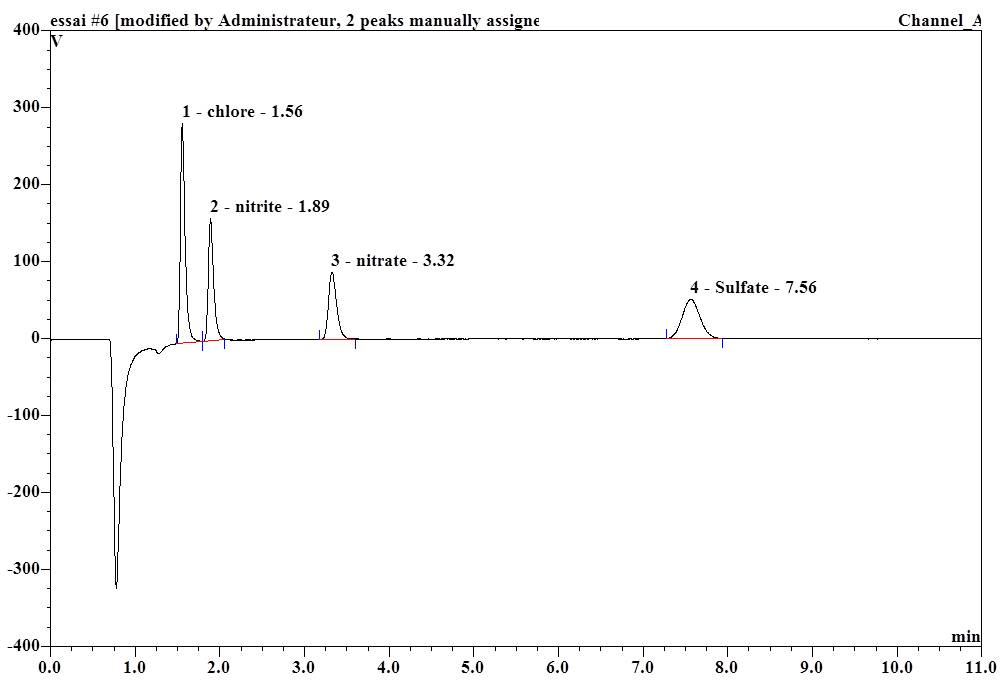
| DIONEX INUVION +Sample charger ASDV (Chromeleon 7.3.2) | Anions : F–, Cl–, NO2–, NO3–, SO42-, PO43- | Ion Exchange AG4A-SC + AS4A-SC (9 mn) | Self-suppression DIONEX ADRS 600 | Isocratic mode (1.8 mM Na2CO3/1.7 mM NaHCO3) (2 mL/mn) |
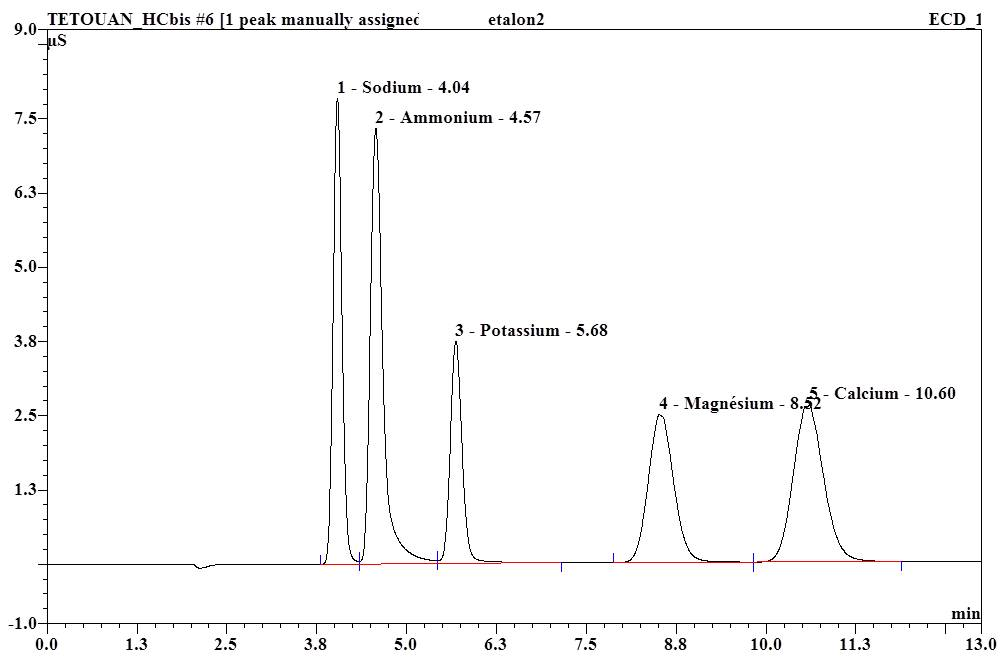
| DIONEX AQUION +Sample charger ASAP (Chromeleon 7.2.10ES) | Cations : Na+, NH4+, K+, Mg2+, Ca2+ | Ion Exchange CG12A + CS12A (14 mn) | Self-suppression DIONEX CERS 500 | Isocratic mode 20 mM CH3SO3H (MSA) (1 mL/mn) |
| DIONEX ICS 5000+ +Sample charger ASAP (Chromeleon 7.2.10ES) | Acids and anions: Acetic, Propionic, Formal and Oxalic, Cl–, NO3–NO2–, SO42-, PO43- | Ion Exchange AG11 + AS11 (19 mn) | Self-suppression DIONEX ADRS 600 | Gradient mode KOH 0,7 mM (11 mn) KOH 7 mM (8mn) (1 mL/mn) |
| DIONEX ICS 5000+ +Sample charger ASAP (Chromeleon 7.2.10ES) | Carbonates | Ion Exclusion ICE-AS1 (15 mn) | Without | Isocratic mode 100 % H2O (1 mL/mn) |
Chromatograms :
Contact : Eric GARDRAT – eric.gardrat@utoulouse.fr
Thermo-optical analysis is a reference method for quantifying organic carbon (OC) and elemental carbon (EC) in atmospheric particles collected on quartz fiber filters. In Europe, the most widely used and recognized analytical protocol is EUSAAR-2.
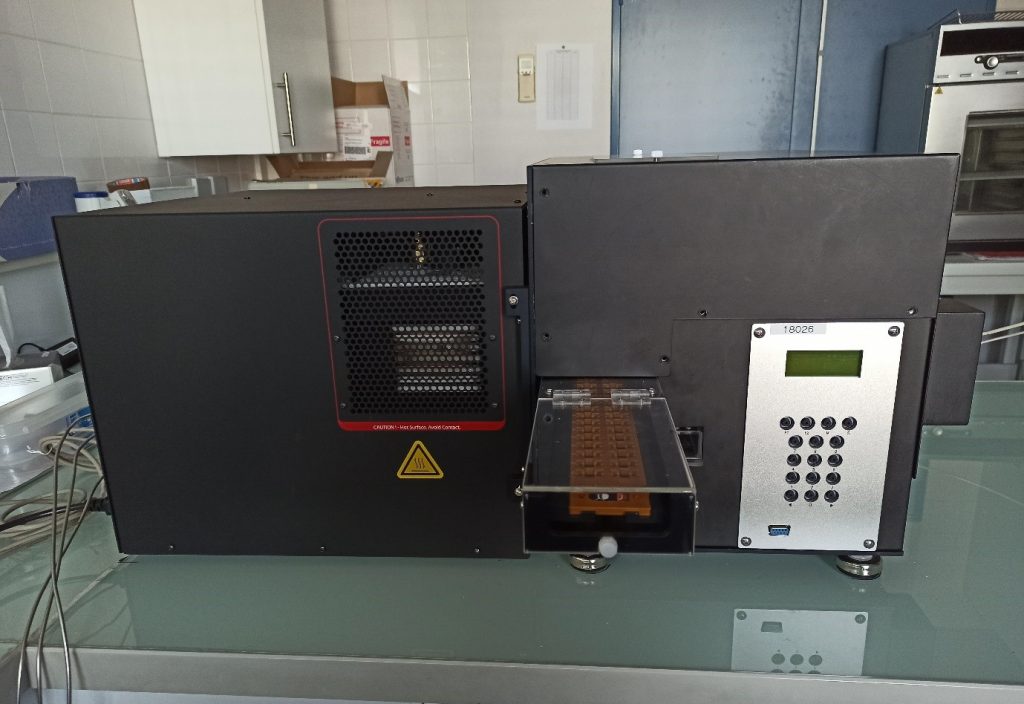
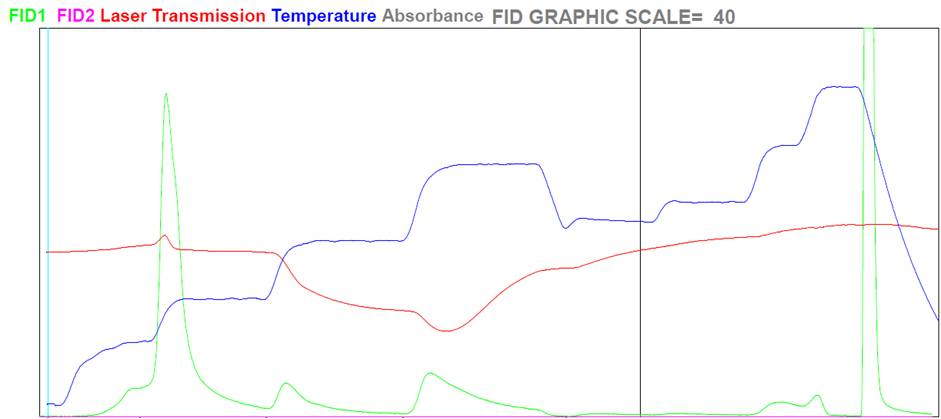
Once the system is sealed and pressurized, the oven is purged with helium to remove ambient air. A stepped temperature ramp is then applied, increasing the oven temperature up to 650 °C, which thermally desorbed organic compounds from the filter. The evolved carbon is oxidized to CO₂ in a manganese dioxide (MnO₂) oxidizing oven and quantified using a non-dispersive infrared (NDIR) detector. After this step, the oven temperature is reduced to 500 °C.
At the end of this first stage, the carbon remaining on the filter consists of elemental carbon (EC) and pyrolyzed carbon (OCpyro), formed through the carbonization of high-molecular-weight organic compounds or natural materials.
The carrier gas is then switched to a mixture of helium with 2% oxygen, and a second temperature ramp is applied to oxidize the remaining EC on the filter. The resulting CO₂ is again detected by NDIR.
The sum of the measured OC and EC fractions corresponds to the total carbon (TC) content of the sample. The optical signal is used to correct for pyrolysis and to discriminate between OC and EC fractions.
Thermogram :
Contact : Maria DIAS ALVES – maria.dias-alves@cnrs.fr
A SARTORIUS MCE3,6P-2S00-M microbalance is specifically dedicated to filter weighing using a specialized weighing pan. 47 mm and 25 mm Teflon filters are weighed before and after aerosol collection.
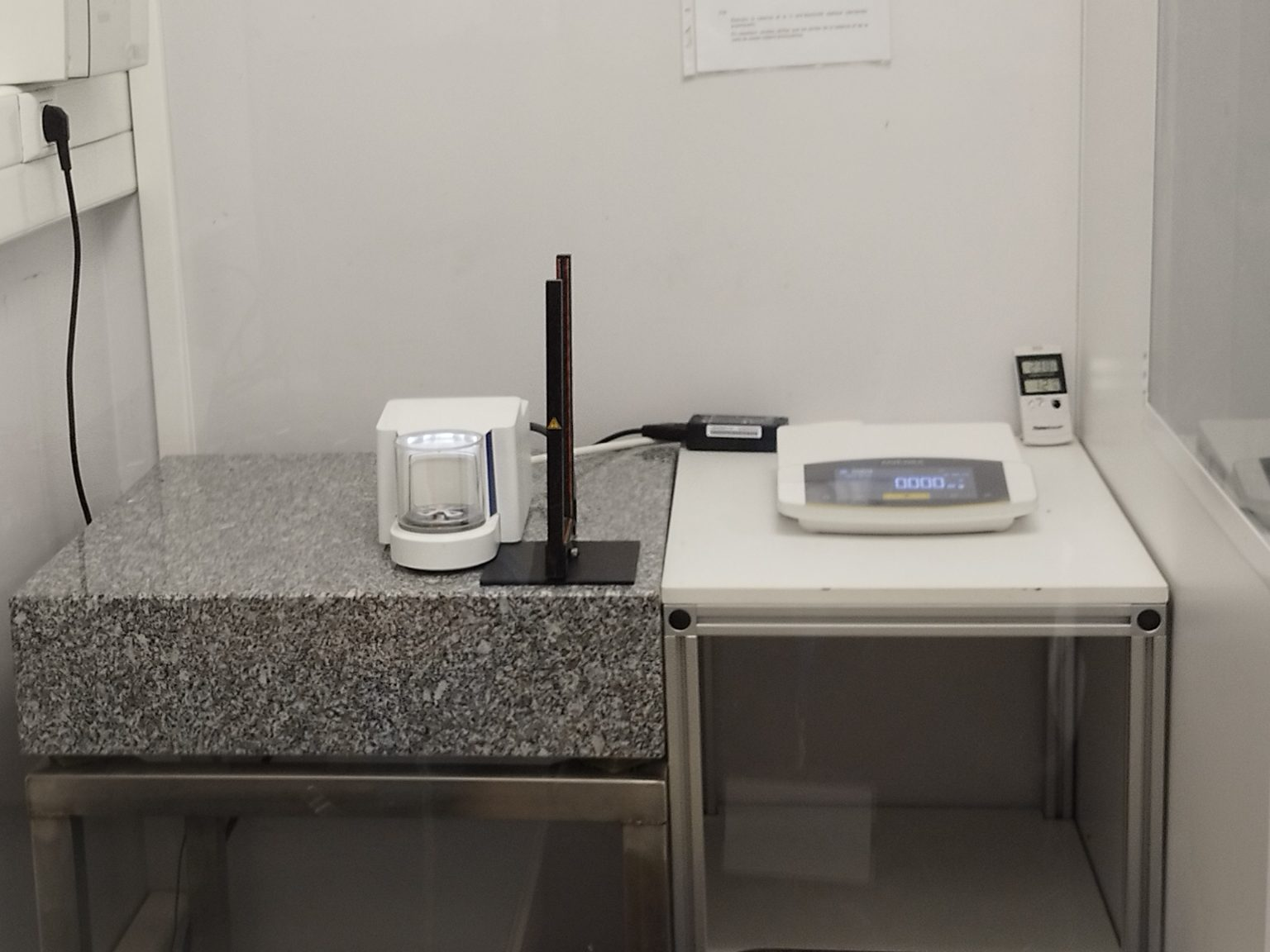
Balance specifications :
- MCE3,6P-2S00-M model from SARTORIUS
- Equipped with a METTLER TOLEDO static electricity generator
- Maximum weight : Max1=3100 mg / Max2=2100 mg / Max3=1100 mg
- Resolution based on maximum weight : d1=0,005 mg / d2=0,002 mg / d3=0,001 mg
- Measuring accuracy of ± 5µg
Contact : Eric GARDRAT – eric.gardrat@utoulouse.fr
Other equipments :
► Balance – SARTORIUS Secura 313-15
► Carbon analyser – BRUKER G4 ICARUS
► Conductivity meter – WTW LF 538
► Dissolved carbon analyser – TOC Sievers M9
► Furnace 450°C – Nabertherm
► Heat chamber – MEMMERT
► Microplate reader – Infinite F200 Pro TECAN
► Muffle furnace 1100°C – Thermolyne F48000
► pH-meter – ATI Orion model 350
► Ultrapure water system – Veolia
INDAAF chemical team

GALY-LACAUX Corinne
IR CNRS
Phone: +33 5 61 33 27 06
Email: corinne.galy-lacaux Dear bot, you will not collect my email@No,No,Nocnrs.fr
Organization:
Laboratoire d’Aérologie (Laero) UMR CNRS/UT n°5560 UMRs IRD n°994, Toulouse, France
Member of:

GARDRAT Eric
IE OMP UPS – Technical manager
Email: eric.gardrat Dear bot, you will not collect my email@No,No,Noutoulouse.fr
Organization:
Laboratoire d’Aérologie (Laero) UMR CNRS/UT n°5560 UMRs IRD n°994, Toulouse, France
Member of:

DIAS ALVES Maria
TCS CNRS – Chemical analyses
Email: maria.dias-alves Dear bot, you will not collect my email@No,No,Nocnrs.fr
Organization:
Laboratoire d’Aérologie (Laero) UMR CNRS/UT n°5560 UMRs IRD n°994, Toulouse, France
Member of:

LENOIR Océane
AI IRD – Chemical analyses
Email: oceane.lenoir Dear bot, you will not collect my email@No,No,Noird.fr
Organization:
Laboratoire d’Aérologie (Laero) UMR CNRS/UT n°5560 UMRs IRD n°994, Toulouse, France